AWS EC2 is one of the most widely used AWS services—but it’s notoriously hard to navigate. I independently designed a feature concept for the EC2 desktop platform, “Beginner Mode”, aimed at improving the user experience for newcomers and enhancing the overall UI.
Making AWS EC2 More Approachable
for Beginners
Making AWS EC2 More
Approachable
for Beginners
First-time AWS EC2 users can feel overwhelmed by dense navigation, unfamiliar jargon, and a complex launch flow.
I redesigned two high-friction entry points: the dashboard and instance setup, and introduced a Beginner Mode concept with guided templates, simplified navigation, and clearer hierarchy.
First-time AWS EC2 users can feel overwhelmed by dense navigation, unfamiliar jargon, and a complex launch flow.
I redesigned two high-friction entry points: the dashboard and instance setup, and introduced a Beginner Mode concept with guided templates, simplified navigation, and clearer hierarchy.
Independent Conceptual Redesign
Case Study Overview
Defined the problem and scope
Designed wireframes and hi-fi UI
Tested prototype with 4 beginners
First-time users face heavy jargon
Navigation is dense and hard to parse
Setup complexity increases drop-off risk
What I Designed
Beginner Mode concept
Guided, template-based setup
Simpler navigation and clearer hierarchy
Tested with 4 participants new to EC2
All preferred redesigned flow
Fewer navigation errors observed than with the current interface.
A “Beginner Mode” toggle concept for the EC2 dashboard and Launch Instance flow, with simplified navigation, clearer hierarchy, reduced jargon, and guided template-based setup.
In 4 peer usability sessions with participants new to EC2, all preferred the Beginner Mode flow, and the redesigned flow produced fewer navigation errors than the current experience.
Wait, what is EC2?
Good question. AWS EC2 (Elastic Compute Cloud) is like renting a computer in the cloud. Instead of buying and maintaining your own physical server, Amazon has an interface that lets you quickly set up a virtual machine with the exact amount of power, memory, and storage you need. You can use it to run apps, host websites, or process data.
Redesign Preview
Understanding The Problem
Product context: AWS EC2 allows users to create virtual machines in the cloud. While powerful, its flexibility can overwhelm first-time users when the interface relies on unfamiliar terminology, dense navigation, and high-stakes setup decisions with little guidance.
Beginner success (first-session progress): A new EC2 user is successful if they can:
Identify where to start from the dashboard
Begin the Launch Instance flow without second-guessing the entry point
Complete key Launch Instance setup steps without getting lost in advanced options or unfamiliar terms
Core issue: Before users can experience EC2’s value, they must first understand where to start, what matters now, and which decisions are safe to make. In the current experience, unclear hierarchy and technical language create friction early, increasing hesitation, navigation errors, and abandonment risk.
How might we help first-time EC2 users navigate the dashboard and instance setup more confidently by simplifying entry points, reducing jargon, and guiding key decisions without taking away advanced control?
Understanding User Needs
Who I Designed For
I identified two broad EC2 user groups with different needs and tolerance for complexity:
Prioritizes confidence and ease of setup over deep configurability
Needs reassurance, clearer terminology, and a guided starting point
Examples: Students, New Professionals, Start-Up Founders, Hackathon Participants
Prioritizes speed, control, and direct access to advanced settings
Does not want simplified flows to block efficient workflows
Examples: Cloud Architects, Site Reliability Engineers.
Design focus: I prioritized first-time and low-confidence EC2 users, while aiming not to slow down experienced operators who value speed and control.
What Community Feedback Revealed
With a better grasp of who is using EC2, I then needed to identify the existing usability challenges in EC2’s interface.
To do this, I reviewed 50+ posts across Reddit and AWS community boards and grouped recurring complaints into themes such as jargon, visual clutter, contrast/readability, and confusing setup flows.
Here are direct quotes that highlighted recurring frustrations around technical jargon, visual clutter, poor contrast, and confusing workflows:
"The visuals take up so much d*mn space on your screen compared to what is actually useful information"
"Color used to draw your eyes to points of action, now it's everywhere. I feel like I can't find anything".
"Why is there no simple option? Like - "Deploy an Instance for me"? As a beginner developer, it is quite hard to ramp up".
"The visuals take up so much d*mn space on your screen compared to what is actually useful information"
"Color used to draw your eyes to points of action, now it's everywhere. I feel like I can't find anything".
"Why is there no simple option? Like - "Deploy an Instance for me"? As a beginner developer, it is quite hard to ramp up".
Key insights from community research:
Technical jargon and unfamiliar language increase hesitation for new users
Both beginners and advanced users benefit from stronger readability and visual hierarchy
The Launch Instance flow appeared repeatedly as a high-priority task in the posts reviewed
Defining the Project Scope through UX Audit
Based on the community research and UX audit, I narrowed the redesign to the two highest-impact surfaces for first-time users: the dashboard and the Launch Instance flow.
My research revealed that EC2 is a vast and complex platform. To create meaningful design improvements, I needed to narrow the project scope. I focused on the dashboard and Launch Instance flow — the first screens beginners see. A Beginner Mode toggle makes the redesign accessible, giving newcomers guidance while keeping full control for advanced users.
Highest Impact Screens and Flows
I prioritized surfaces where users start, make key decisions, and are most likely to hesitate or drop off.
My research revealed that EC2 is a vast and complex platform. To create meaningful design improvements, I needed to narrow the project scope. I focused on the dashboard and Launch Instance flow — the first screens beginners see. A Beginner Mode toggle makes the redesign accessible, giving newcomers guidance while keeping full control for advanced users.
Why is it important?
The dashboard is the first screen many users see, so it shapes whether they can identify a clear starting point or feel lost immediately.
What will change?
Simplify the dashboard by reducing clutter, emphasizing essential actions, and creating a clearer entry point into EC2.
Why is it important?
The dashboard is the first screen many users see, so it shapes whether they can identify a clear starting point or feel lost immediately.
What will change?
Simplify the dashboard by reducing clutter, emphasizing essential actions, and creating a clearer entry point into EC2.
Why is it important?
Launch Instance appeared repeatedly as a high-priority task and is the point where beginners face the most setup decisions.
What will change?
Simplify setup with guided templates for common use cases, clearer layout and contrast, and less technical jargon.
Why is it important?
Launch Instance appeared repeatedly as a high-priority task and is the point where beginners face the most setup decisions.
What will change?
Simplify setup with guided templates for common use cases, clearer layout and contrast, and less technical jargon.
Redesign the dashboard and Launch Instance flow, and introduce an optional Beginner Mode toggle to make key tasks easier for first-time users. This approach aims to reduce early friction, clarify entry points and setup decisions, and preserve full control for advanced users.
Redesign the dashboard and Launch Instance flow, and introduce an optional Beginner Mode toggle to make key tasks easier for first-time users. This approach aims to reduce early friction, clarify entry points and setup decisions, and preserve full control for advanced users.
Why an optional mode instead of simplifying the default experience?
I explored whether to simplify the default EC2 interface for everyone, but chose an optional Beginner Mode because EC2 serves both new and advanced users. The toggle reduces complexity for first-time users without disrupting expert workflows. Rather than replacing the standard experience, Beginner Mode acts as a learning layer that helps users transition into the full EC2 interface over time.
A quick question you might be wondering: why a toggle? Why not a different approach?
I explored whether to simplify the default EC2 interface for everyone, but chose an optional Beginner Mode because EC2 serves both new and advanced users. The toggle reduces complexity for first-time users without disrupting expert workflows. Rather than replacing the standard experience, Beginner Mode acts as a learning layer that helps users transition into the full EC2 interface over time.
Ideation and Wireframing
Based on the research and defined scope, I created early wireframes to explore how a simpler dashboard, guided setup, and clearer hierarchy could make EC2 feel more approachable for beginners.
Dashboard Wireframe Exploration
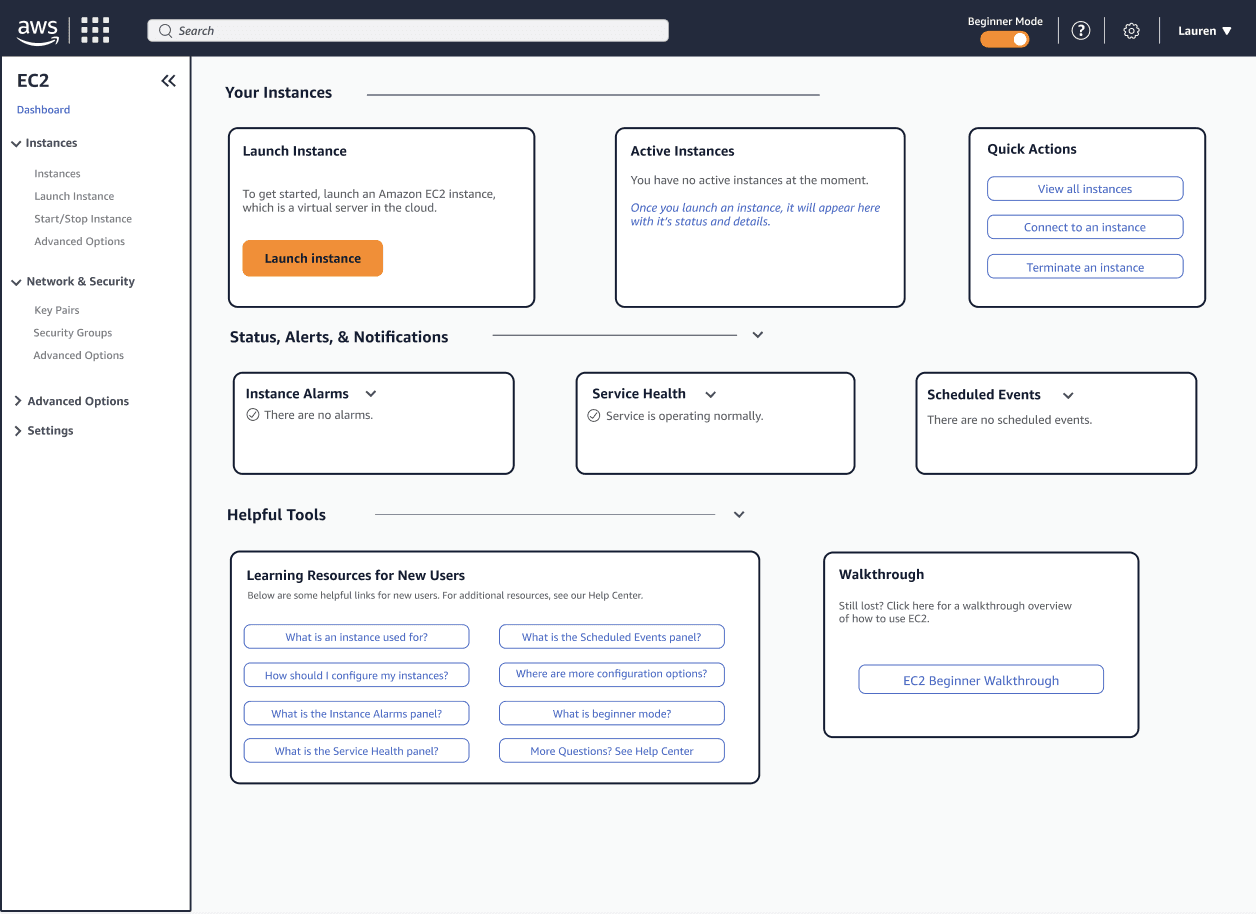
Beginner Mode toggle: A clear on/off option so first-time users get guidance while advanced users retain control
Simplified navigation: Advanced options are tucked away to reduce noise and make the sidebar easier to parse
Card-based layout: Core actions are surfaced through larger, clearer modules to improve hierarchy and reduce overwhelm
Launch Instance Flow Wireframe Exploration
Template-based setup: Introduces common starting points so beginners can begin with guided configuration instead of making every decision from scratch.
Step-by-step structure: Breaks setup into clearer stages so users can focus on one decision at a time.
Simplified language and guidance: Uses clearer labels and helper text to reduce confusion around technical terms and setup choices.
Visual Design
Comparison to Current AWS EC2 Dashboard and Launch Instance Flow
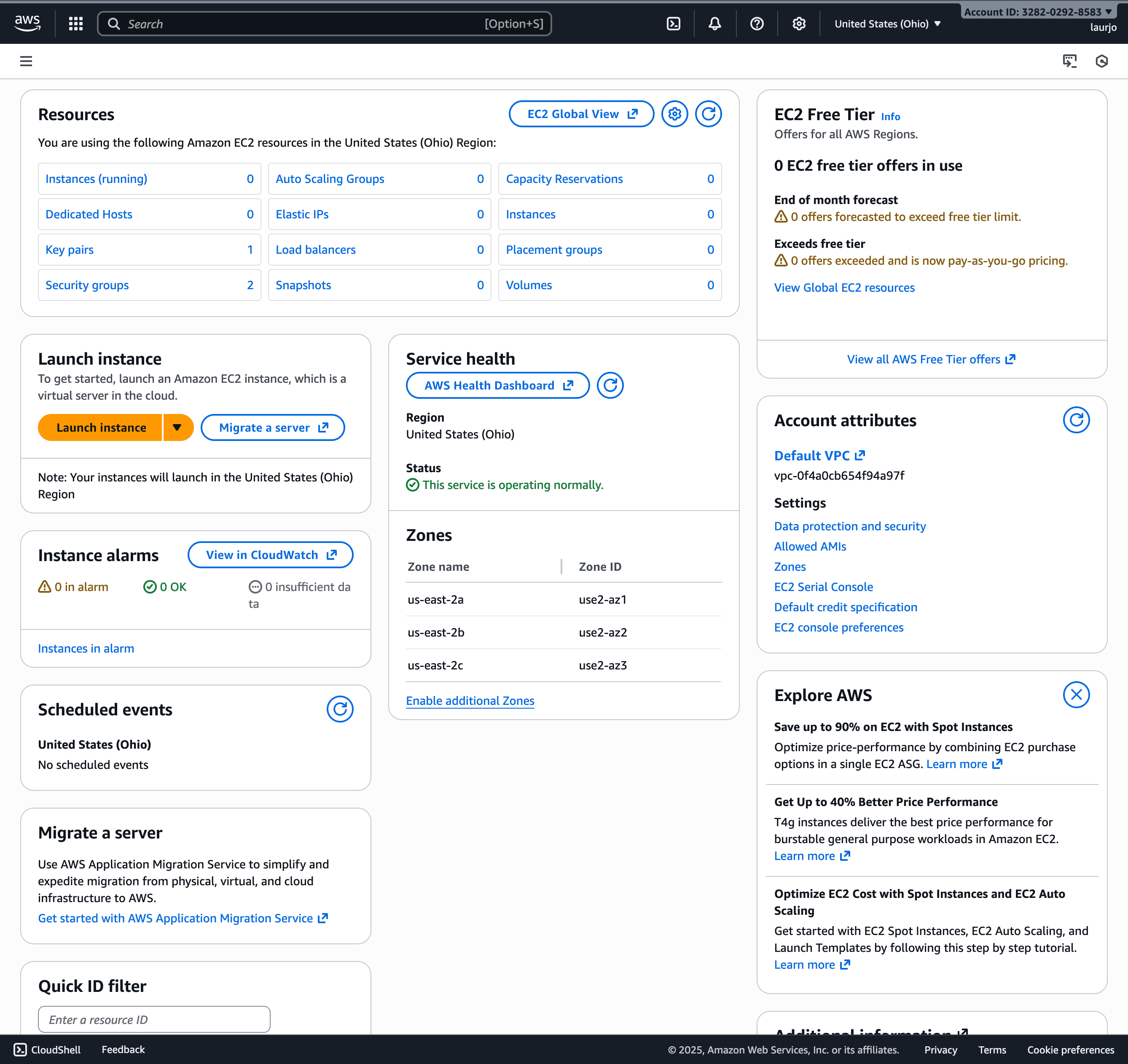
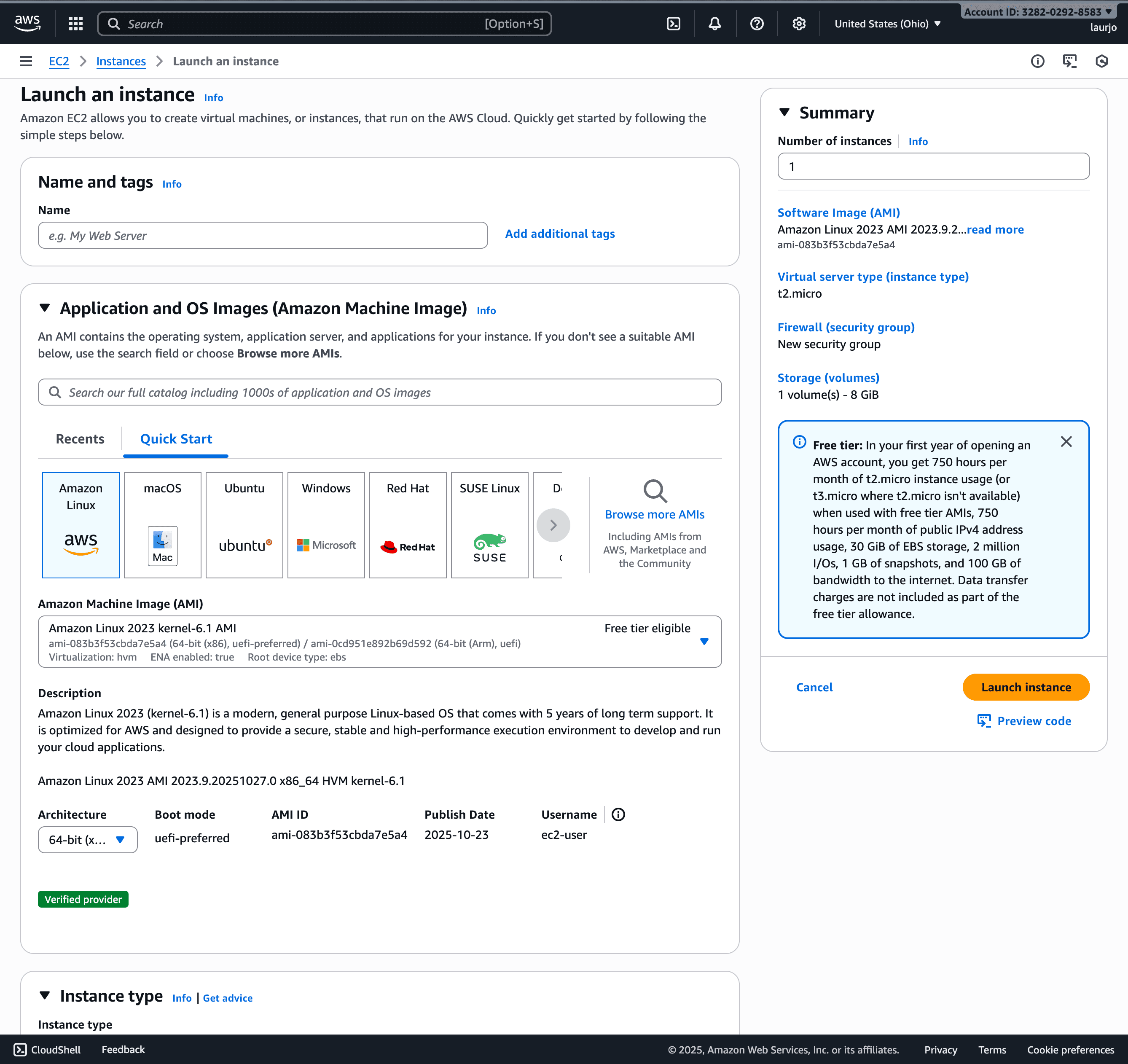
To ground the redesign, I first reviewed the existing AWS EC2 dashboard and Launch Instance flow. While powerful, both surfaces present beginners with dense information, weak visual hierarchy, and technical terminology that make key actions harder to recognize.
To ground the redesign, I first reviewed the existing AWS EC2 dashboard and Launch Instance flow. While powerful, both surfaces present beginners with dense information, weak visual hierarchy, and technical terminology that make key actions harder to recognize.
Early High-Fidelity Explorations
I explored multiple high-fidelity concepts early in the process to quickly evaluate layout, hierarchy, and visual style. These versions helped me validate what worked, identify friction points, and refine the experience before finalizing the design.
I explored multiple high-fidelity concepts early in the process to quickly evaluate layout, hierarchy, and visual style. These versions helped me validate what worked, identify friction points, and refine the experience before finalizing the design.
I initially explored designs that stayed close to the existing AWS visual system to better understand the design language and constraints. While this approach was useful early on, feedback showed that elements like low contrast, heavy borders, large unused areas, and a top header with unclear actions still created cognitive load for beginners.
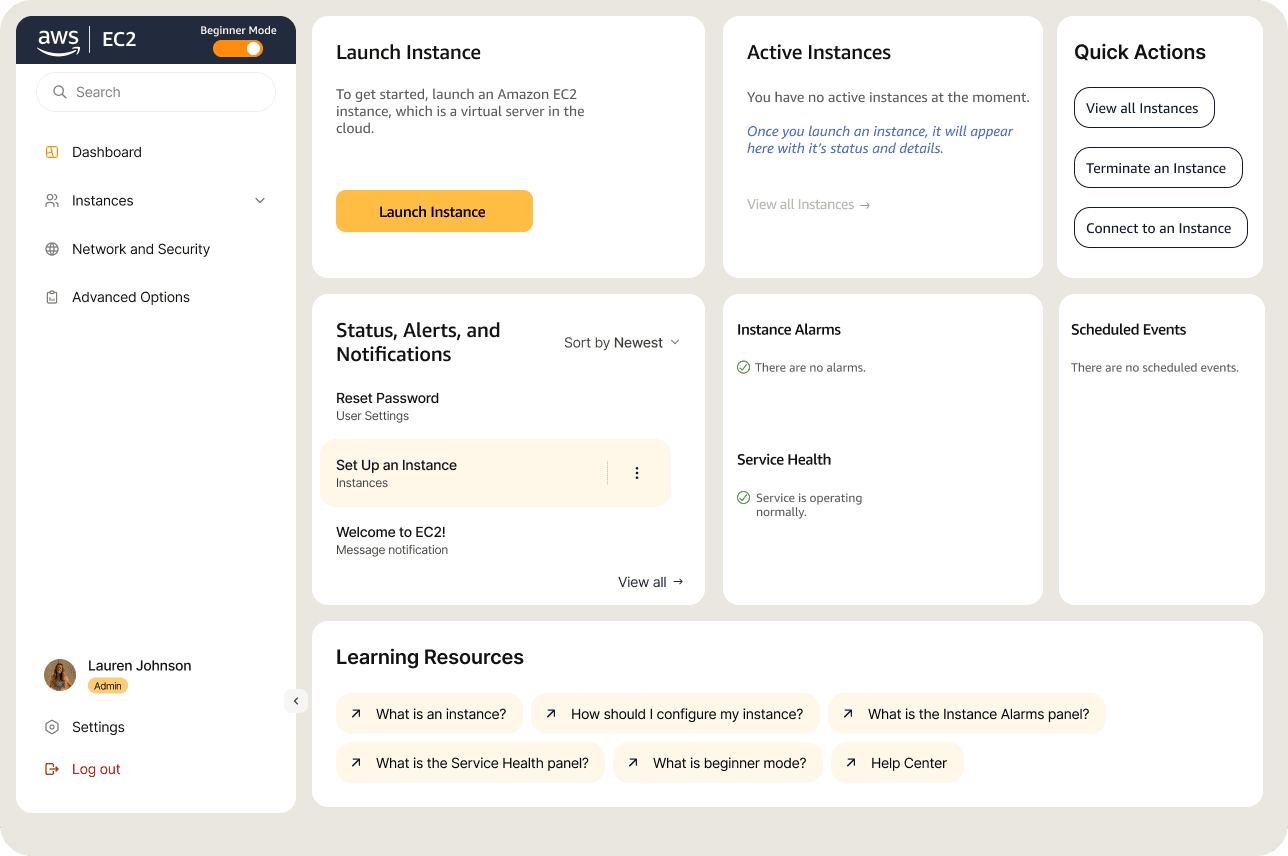
Based on insights from user feedback and previous iterations, I transitioned to a lighter, more streamlined interface that prioritizes clarity, readability, and confidence for new users. I also consolidated the header into the left navigation to reduce redundancy and surface navigation in a more intuitive location.
I initially explored designs that stayed close to the existing AWS visual system to better understand the design language and constraints. While this approach was useful early on, feedback showed that elements like low contrast, heavy borders, large unused areas, and a top header with unclear actions still created cognitive load for beginners.
Based on insights from user feedback and previous iterations, I transitioned to a lighter, more streamlined interface that prioritizes clarity, readability, and confidence for new users. I also consolidated the header into the left navigation to reduce redundancy and surface navigation in a more intuitive location.
I initially explored designs that stayed close to the existing AWS visual system to better understand the design language and constraints. While this approach was useful early on, feedback showed that elements like low contrast, heavy borders, large unused areas, and a top header with unclear actions still created cognitive load for beginners.
Finalized Visual Design
Based on insights from user feedback and previous iterations, I transitioned to a lighter, more streamlined interface that prioritizes clarity, readability, and confidence for new users. I also consolidated the header into the left navigation to reduce redundancy and surface navigation in a more intuitive location.
The Final Feature
The final concept includes a streamlined dashboard with a Beginner Mode toggle and a simplified Launch Instance workflow with guided templates and reduced jargon. Visual hierarchy, contrast, and readability were strengthened to make key actions easier to scan and understand.
The final concept includes a streamlined dashboard with a Beginner Mode toggle and a simplified Launch Instance workflow with guided templates and reduced jargon. Visual hierarchy, contrast, and readability were strengthened to make key actions easier to scan and understand.
The final concept includes a streamlined dashboard with a Beginner Mode toggle and a simplified Launch Instance workflow with guided templates and reduced jargon. Visual hierarchy, contrast, and readability were strengthened to make key actions easier to scan and understand.
Outcomes
In 4 moderated prototype sessions with peers new to EC2, all participants found the Beginner Mode concept easier to understand than the current flow.
Participants made fewer navigation missteps and asked fewer clarification questions while completing the launch task.
Because this was a small peer test rather than testing with actual EC2 users, these findings should be treated as directional rather than conclusive.
Designing for a technical domain required deeper product learning before interface exploration.
Simplifying complexity meant guiding decisions for beginners without removing expert control.
Future validation should involve actual EC2 users to test whether the proposed changes reduce friction in real workflows.
Limitations: Testing was conducted with peers new to EC2 rather than actual EC2 users, so findings are directional.
Designing for a technical domain required deeper product learning before interface exploration.
Simplifying complexity meant guiding decisions for beginners without removing expert control.
Future validation should involve actual EC2 users to test whether the proposed changes reduce friction in real workflows.
Limitations: Testing was conducted with peers new to EC2 rather than actual EC2 users, so findings are directional.